Monday, November 12, 2012

New Skills Monday Lesson from The Mat

Each week, usually on Sunday evening I teach a lesson on The Mat. These are wide ranging and varied and well received by my subscribers.
It is such a gloomy day here I want to spread some sunshine.

Here is one from July where I explore what else we can do with our wool strips. This makes for a long blog post, but it seems new thinking like this is the key for further explorations to unknown territories with our tools.


New Skills Monday- Beyond The Strip - 10 Ways to Decorate - July 22/2012

Often when I think about new things to do with hooking there are many influences that come into play.
1. I've been looking at a machine that will make hand stitching on cloth (very indulgent as it only does one thing)
2. I like the tradition and look of Shashiko, my friend Deb gave me a bag with Shasiko she made a few years ago.
3 I've been reading the Alabama Chanin books ( many thanks to Jerry who taught me to say it properly)
4 I tried it out myself, just stitching on leaves. I'll add the picture of my T shirt when it emerges pristine from the laundry!
5. I got to thinking about the running stitch and our strips. In my embellishment days I have done many things to strips. 
On top of loops I have:
beaded, sequined, over layed, french knotted and dry felted
To the strips before hooking I have:
Tapered, cut indents on one side for a zipper teeth effect, carried yarn along and under,
unravelled threads on one side for eyelashy implications, I have done the "fancy stitches" 
What else I thought could be done, what else? I thought I did it all.
Then when we were at our Asheville retreat, I reckon you were there in spirit, we had a morning of thinking about and experimenting with innovation, one of the foundations of being an artist.
There are only certain fixed things we can do before we would deviate from hooking.
We have our tools, the way they work and the material we work with.
Strips are one of those.
I encouraged everyone to think about what else can be done with the strip.
We didn't have time to think more or act on it but I said: what if we made a running stitch down a strip of wool and hooked it?
The following might not be "for you". But I encourage you to read it as it just might get you thinking about doing something else that will be more comfortable for your explorations
There is more to this than the running stitch too because as I began to explore I thought of what else might be possible and tried it.
I've done these samples by hand.
Notes about making your running stitch by hand: 
I used a tapestry needle
Use a double thread
Make your stitches so they will show up , if you aren't sure where your stitch should be placed, hook a row and dot a sharpie on top of each loops, then  pull out, you'll see your stitch pattern emerge if you cover the dots.
See my samples named 1 to 5 going from left to right. If you click on this photo it will get bigger. It will also take you away from this page.
Number 1
In this sample I used silk in a running stitch that would show up with sheen in my loops.
 The colour changes make this an interesting addition, you can see the wool with stitching to the left.
Number 2
This sample is more subtle, I used embroidery floss with a colour already present in the plaid, making it blend in but adding for me some dark in the middle I might want.
Number 3
This is also a showy sample, I just imagined I needed a glimmer by the edge of a lake or a dust of snow on a branch, it helps us keep off the edge and onto the top of things. I used sockotta yarn.
Number 4
Wow, this has some stellar impact, I want to explore it more for doing outline of petals or flower centres, it has a happy jolt that among a bunch of plain stitches will make something interesting happen for the eye. It is a dyed silk noil thread
Number 5
I like the warm cool frisson here and can see it would add impact to a sparkle line. It is bamboo thread for weaving.
And now for my next samples, 6 through 10 
Number 6.
This sample involves hand stitch too, after I had hooked my loops I ran some hand spun yarn through the the loop and added some intermittent knots. I like the look of the irregularity and can see this a certain sized trunk or even for an small eye, maybe an ornate flower centre like a poppy.
NOTE:
I've used machines for the rest of the samples
Number 7
With this strip I used my felting machine to lay a number 3 strip on a number 12, I love this and will be using this in my work when called for. The layering and of course gradation appeal to me a great deal.
Number 8
Using the same sockotta yarn as I did in example 3, I did a narrow long zig zag stitch on my sewing machine over it in the middle of the strip. I like the way the red zig zag tempered and disguised it somewhat.
Number 9
As I was thinking I saw a piece of used washed lining from a recycled garment sitting near me. A few months ago as part of my delightful sewing fun I got this product suggested by Marcy and Katherine Tilton. LITE Steam a Seam 2.
 This helps you place funky pockets and such so you can "glue or fuse" down what you want to sew on something. It is very good and not too sticky, but once stuck together the "fuse" is very stable.
I used it to cover up craziness on my Marie Osmond bag. And after much abuse the fused parts are holding steady, you can get it at most every sewing store.
Following the manufacturer's suggestion I fused the lining to wool and suddenly I had some pretty great shiny fabric to hook, the wool backing worked a treat to let more shine show. Susan Schimdt used to make wool with a shiny/ sparkly side when I first started hooking but I haven't seen it lately. I thin it was called Fusion wool?
There are many fabrics that could be fused for hooking this way, think of using thinner ones.  It cut like a dream.
Who knows what else you might use with the fuse?
Here is a close up of the fabric each side:
Number 10
Here I'm showing the whole cloth for the number 10 example before cutting on the cutter
On the bottom I just used the same long narrow zig zag and stitched all over the wool.
On the top I used my felting machine to felt handspun and various yarns to the top of the wool.
When it was cut and hooked you can see in the middle where there is no decoration.
I like the surprise of the threads appearing and the fuzzy colour changes in the felting.
It makes it into new cloth with a a wider possible purpose.
I aso had fun with the felter by laying over a fine scrim of roving and felting it down, it changed the stauration and value as distance might, that will probably set me off on another tangent.
I think there is much to explore as we expand our thoughts and delve deeper into self expression through wool.
Let me know if you like this, need feedback to provide you with what you want.
Thanks!

O gee it is nothing to do with this young man

This is not a cougar speaking, trust me.


I just happen to LOVE ogees
What a clever idea for reuse of thrift store garments from Junky Styling
They do it for women too.


This would make a cool rug subject, the ogees I mean.

Friday, November 9, 2012

Studio Tour + Wool Shrinkage


Here is the video of  our portion of the Around the Sound Studio Tour 2012


It is a great experience to display your work for the public, such lovely feedback and how compelling spinning is to men and boys and how hooking brings up memories and itchy hands to try it! Very gratifying and the sales were great too, always welcome that.

Happy Friday from the Welcome Mat to you, an excerpt of some of the interesting things we ponder there.

How much does wool shrink through dyeing?

This much.
1/8th yd of natural wool dyed, rinsed in washer and dried in dryer on medium heat and under it an undyed 1/8th yd

Sometimes you win and sometimes you learn.” – Robert Kiyosaki

I'll take learning any day.

Thursday, November 8, 2012

This Week's Dye Recipes + Translations

Taking a pause to look outside I was inspired by my neglected garden, a study on the slow return to nature style of horticulture.
I've used the dyes listed directly below each colour to make them.

And it has been awhile since I gave you a gift of colour here.

I hope you know I still love you even through my dreadful and conspicuous neglect.

Here is my favourite orange of all time, well at least right now.
I call it Faithful Passion
Majic Carpet Dyes 

1 part blue violet 
2 parts orange

For this 1/8th yd. of wool 
1/64 tsp. Blue Violet
1/23 tsp Orange


I think you could use most any orange and add violet to it and something somewhat similar will happen.
Cushing users try- Orange and Purple with the same ratio
Proc chem users Try Orange 233 and Violet 818 in the same ratio but add a 1/256th Magenta

Even if you don't like orange this one fits in well to most colour ways.

Go forth and dye, it is a sure fire way to kick November's Donkey, just looking at these fiery colours helps, who needs a SAD lamp when you have orange? Bask in the glow of orange.

"There is no blue without yellow and orange."
Vincent Van Gogh

Wednesday, November 7, 2012

Microwave Dyeing Question & A Video Tutorial


Wanda, thank you for the video. I know you do a lot of dying via the microwave. I was told yesterday that doing it via the microwave you end up cooking your wool. Would you mind providing me with your comments?


Dear Welcome Mat member,

You ask such a good thing this morning I might have to add it to my public blog. ( see?)
I don't really do a lot of dyeing in my microwave but I do use it for small samples,my RHM work and my weekly ( recipe rich using all 3 main dye companies)  dyeing column for the Welcome Mat. I also use it to heat up dye to aid dissolving when needed. I think it is a useful tool for people who are not doing production dyeing. 
On a happy note I can certainly tell you after dyeing hundreds of yards of all kinds of wool fabric over 15 years of dyeing seriously, the wool as a finished product dyed in the microwave is indistinguishable from that done in the oven, stove top, b-b-q, over campfire, hotplate, crock pot, electric frying pan or wok. I've tried them all!!! 
I'm an explorer and as I explore I take you along for the ride. You can just sit in the car along the way or get out and touch the giant ball of string or gargantuan goose or look over the edge of that canyon with me. It's all up to you.
I think the best thing I can tell you when you hear varying opinions of so called experts: Don't substitute your intelligence for that of someone else's. Try it out and test the results for yourself.


I like to think of this quote ..... often .....

Believe nothing, no matter where you read it or who has said it not even if I have said it, unless it agrees with your own reason and your own common sense. 

signed Buddha.


++++++++++++

This month in Rug Hooking my article is about microwave dyeing. I show you various dye methods we are mostly familiar with but using the microwave as the heat source. Here is a video demonstrating transitional dyeing via the microwave with the added interest of the echo, Michele Micarelli taught me that! Getting more wool coloured for the same amount of effort - divine!


Also someone noted in a letter yesterday I neglected to mention which dyes I used. I don't have a copy yet so I don't know but just in case  .... I used Majic Carpet dyes but truly you can use any dyes you have and love with these methods as long as they are for wool!

I just got this shining accolade about my article yesterday, turning someone on about dyeing, more precious to me than kittens sleeping in a pile or a truckload of wool. 

The other article I wanted to comment on was the microwave dyeing article.  I am a 'chicken dyer'.  When I saw the platter, and the glass measuring cup I had a 'duh' moment.  I was so excited I picked up my iPad and logged on to watch the video.  It was excellent.  Thanks.
So, I heartily urge you to provide more videos.  And thanks for the modern approach as well as the traditional methods of rug hooking.


For your edification there are many videos on dyeing in the microwave I just discovered this morning on youtube, go and discover.
Have a great day!

Tuesday, November 6, 2012

Other Ways To Measure Wool for Dyeing


I had this good question today about my article on microwave dyeing in the November/December issue of Rug Hooking magazine. Below is a photo of one method I wrote about, transitional dyeing in the microwave. I'll be releasing a video to show you how to do this.  I look like hell by the way, at least the wool is pretty. This video also includes a new recipe to use.


And now for the question:
"Great article on microwave dyeing in Rug Hooking Magazine! One question about the amount of yardage. I see that the recipes reference 1/8th yard. Is that 1/8th of a square yard so I can calculate square inches? It would be really helpful to have it clarified in terms of square inches since I have a lot of inherited wool with a variety of widths, lengths and oddly shaped pieces.

I've just been to your website. Wow! Now how will I ever get to work on time today?!
Thank you"


Here is my reply:


Fabric doesn't run in square yards like lumber or flooring, it is measured along the selvedge. You probably already know this.
A yd of wool is 36" along the selvedge and 54" across.
1/8th of this (by rug hooking standards) is 18" ( half of the 36" yd length) x 14" 
In weight ( always a great way to deal with disparate wool pieces) 1/8th yd. of the natural wool I dye weighs about 1.5 to 1.6 oz.

Happy creating,
Wanda

Monday, November 5, 2012

Beautiful Things for Gifts

It is sorta getting to be that time of year where we need to turn our minds to gift giving.
At Brenda Watts Woodwork there are many very lovely fine crafted of wood, if you look carefully on the linked page you will even see a hooked rug.
I loved the owls of course and the labrador mermaid, of course labradors are mermaids!


Sunday, November 4, 2012

Proceed With Caution - Dyeing With Kool Aid


Somethings worry me, deeply.
I don't know why. But they do.

Like seeing dyeing instructions using koolaid - who should care?
But I do, I care deeply when you go to all that expense and work only to have the colour in your rug fade faster than the sun on a November day.

It is all well and good to dye yarn this way. Maybe the yarn products will make their way out of a dark sock drawer or deep sweater closet once or twice a week, to be placed in shoes and under coats. No problem!!

Our rugs are "out there" no where near the shadowy closets and drawers, exposed to our number one enemy, LIGHT on a constant daily basis.
Harm comes, wool fades back to natural or the pre-dyed colour pretty quickly,
leaving your rug looking like an experiment in saturation.

If you want to give dyeing a spin to see if it suits your sensibilities and interests by all means try a little kool-aid, it has citric acid right in it, making it a dump in and dye proposition.
But it ain't for people who want lasting rugs and it ends up being quite expensive as compared to dyes made for home dyers.

While I'm on the subject of dyeing will you indulge me another minute? Anything using dirt, rust, organic matter like onion skins, including tea, coffee or juice and relies on wrapping, laying, layering, soaking cloth in any of these objects is 'staining' not really dyeing though both change the colours of an object.

Thank you for letting me lay down my ponderous and heavy burdens today.
Go forth and do both meaningful and good work and please while at it, do no harm to yourself or others.

Friday, November 2, 2012

You think it will work.... and it does!


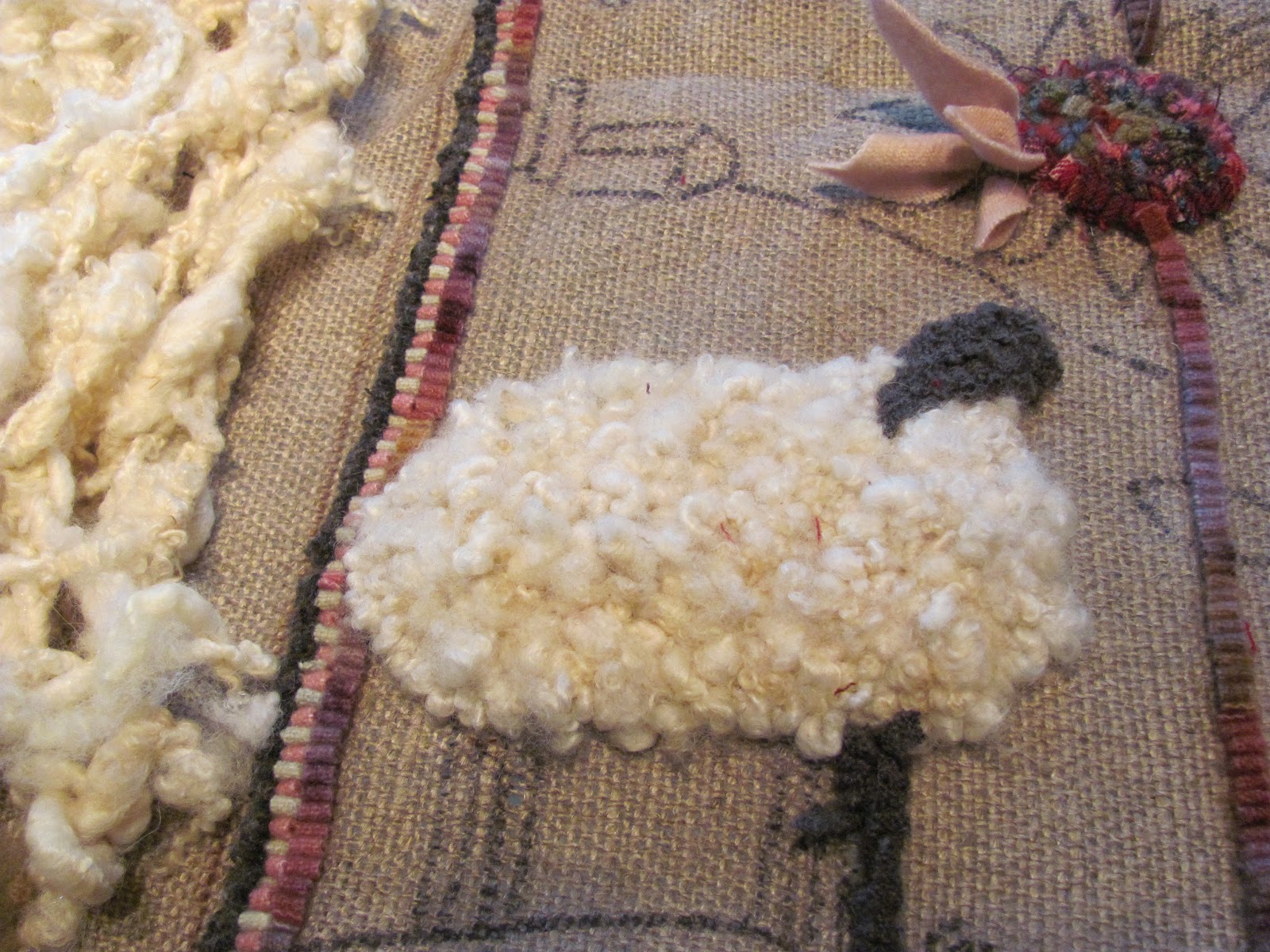
Dianne was hooking a sheep and I had spun the yarn on the left straight from a BFL lamb's first fleece. It is funky yarn with lots of locks and loops and I thought it might be perfect for a sheep and here is the results - so much fun, Dianne you did a great job!

In our bi- weekly classes here at the studio we are hooking this rug:

Hooked by Jane Legge

This is also a pattern reproduced for the members of The Welcome Mat
It is a lovely pattern which can depict day or night, any season and weather.


To get ready for class I took these bundles and turned them into browns


And these became green and blue


Here they are:

What great fun and the rugs are turning out great! 
 Will they have glimmer, glow or glamour?
I'll show you soon.

If you love to redye or over dye I just published an article called silk Purse on the Mat today on a variety of ways to do this and hints on what is needed for those sow's ears.
I also have a overdyeing chart that is not dye company specific, you might love to own.
Results of one colour dyed over another are clearly spelled out.
The relevant info is black out here.
Isn't it beautiful?

It is a bonus for all Welcome Mat members.

The lone pine is a motif I love to return to time and time again:
(notice the table art says love at that seat!!)

What motif do you love to hook over and over?